Prophecy of Canterville
The Canterville GhostThe Prophecy of Canterville is a six-line verse on the library window whose obscure conditions give meaning to Virginia Otis’s intervention in Sir Simon’s fate. It links the stillness of Canterville Chase to a golden girl’s prayer and tears, the flowering of a barren almond tree, and mercy for the ghost. When Virginia fulfills these signs, the prophecy turns the house’s long haunting toward forgiveness, burial, and peace.
The Verse and Its Conditions
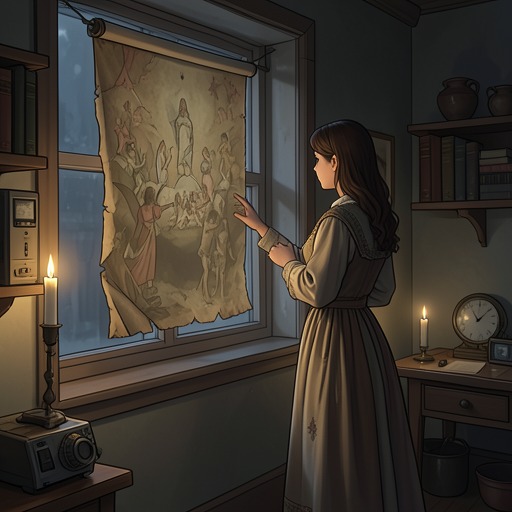
When Sir Simon asks Virginia whether she has read the old prophecy on the library window, she says she knows its six difficult lines by heart but does not understand them. The verse promises that, when a golden girl can win prayer from the lips of sin, the barren almond bears, and a little child gives away its tears, the house will be still and peace will come to Canterville. Its language joins three signs—a child’s prayer, the sharing of grief, and an unlikely blossom—to the end of the haunting.
The prophecy is not presented as an explanation Virginia can independently decipher. Sir Simon interprets its requirements for her: she must weep with him for his sins because he has no tears, and pray with him for his soul because he has no faith. If she remains sweet, good, and gentle, he says, the angel of death may show him mercy. He also warns that fearful shapes and wicked voices will try to frighten her, though the purity of a child can withstand them. The prediction thus makes Virginia’s compassion, not a contest of strength, the necessary means of his release.
Virginia’s Acceptance and the Passage
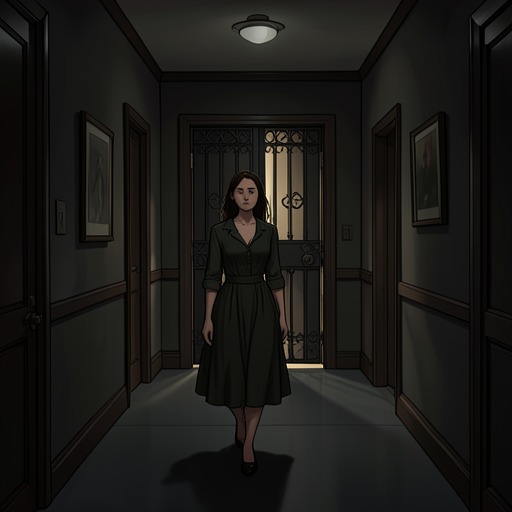
Virginia trembles and falls silent after hearing what the prophecy demands. Yet when Sir Simon wrings his hands in despair, she rises, pale but resolute, and promises she is not afraid and will ask the angel for mercy. Her decision gives the verse practical force: its “golden girl” is no distant figure but Virginia, who chooses to accompany the ghost despite the dangers he has described.
Sir Simon takes her hand and leads her through the Tapestry Chamber. The embroidered huntsmen call for her to go back; carved creatures warn that she may never be seen again. She shuts her eyes against them and continues with him. At the room’s end, the wall fades, revealing a black cavern; a bitter wind sweeps around them, and something pulls at her dress. Sir Simon urges her to hurry, and the wainscoting closes behind them, leaving the chamber empty. The ordeal gives the prophecy’s promise of prayer and tears a physical passage into the hidden place where the truth of his fate can be witnessed.
Fulfillment and the House’s Stillness
After Virginia returns, she tells her family that Sir Simon is dead and leads them through the concealed opening and a narrow corridor to a low, vaulted room. Behind a heavy oak door, they find his gaunt skeleton chained to an iron ring in the wall. It lies stretched across the stone floor, reaching toward a trencher and ewer set just beyond its grasp; the jug is green with mould, and the trencher holds only dust. Virginia kneels beside the remains and prays silently. The family looks on as the hidden tragedy that had sustained the haunting is disclosed.
At that moment, one of the twins sees the old withered almond tree blossom in the moonlight. The bloom answers the prophecy’s most visible sign, while Virginia’s prayer and her earlier willingness to grieve with Sir Simon complete its human conditions. She rises and says God has forgiven him; light seems to illumine her face. The prophecy’s final promise—that the house will be still and peace will come to Canterville—therefore follows not from the defeat of a supernatural adversary but from Virginia’s act of mercy and the revelation of the ghost’s suffering.
Burial and the Meaning of Peace
Four days later, a funeral leaves Canterville Chase at about eleven at night. Lord Canterville comes from Wales as chief mourner, and Virginia rides in the first carriage with him. The procession includes the Otis family and Mrs. Umney, who is acknowledged as having a right to see the end of the ghost who frightened her for more than fifty years. The coffin is carried to a grave beneath an old yew in the churchyard, where the service is read by the Reverend Augustus Dampier.
As the coffin is lowered, the servants extinguish their torches according to an old Canterville custom. Virginia lays a cross of white and pink almond blossoms on the coffin. The moon emerges from behind a cloud, and a nightingale sings from a distant copse; thinking of Sir Simon’s description of the Garden of Death, Virginia is moved to tears and speaks little on the drive home. The burial translates the prophecy’s promised peace into a public rite: the ghost’s remains receive a grave, and the flowering tree’s sign accompanies him into rest.
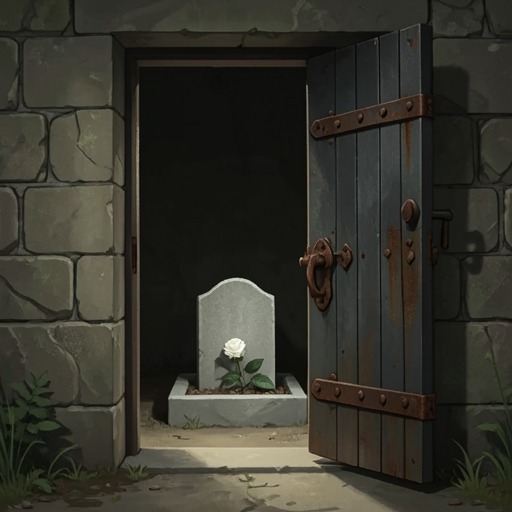
The verse also remains attached to Sir Simon’s memory after the house has become quiet. When the Duke and Duchess later visit his grave, the inscription has been settled as his initials and the verse from the library window. Virginia lays roses on the grave, connecting the prophecy once more with flowers and remembrance. Its fulfillment is thus both an ending to the haunting and a lasting account of how a child’s prayer, grief, and gentleness secured forgiveness for the ghost.